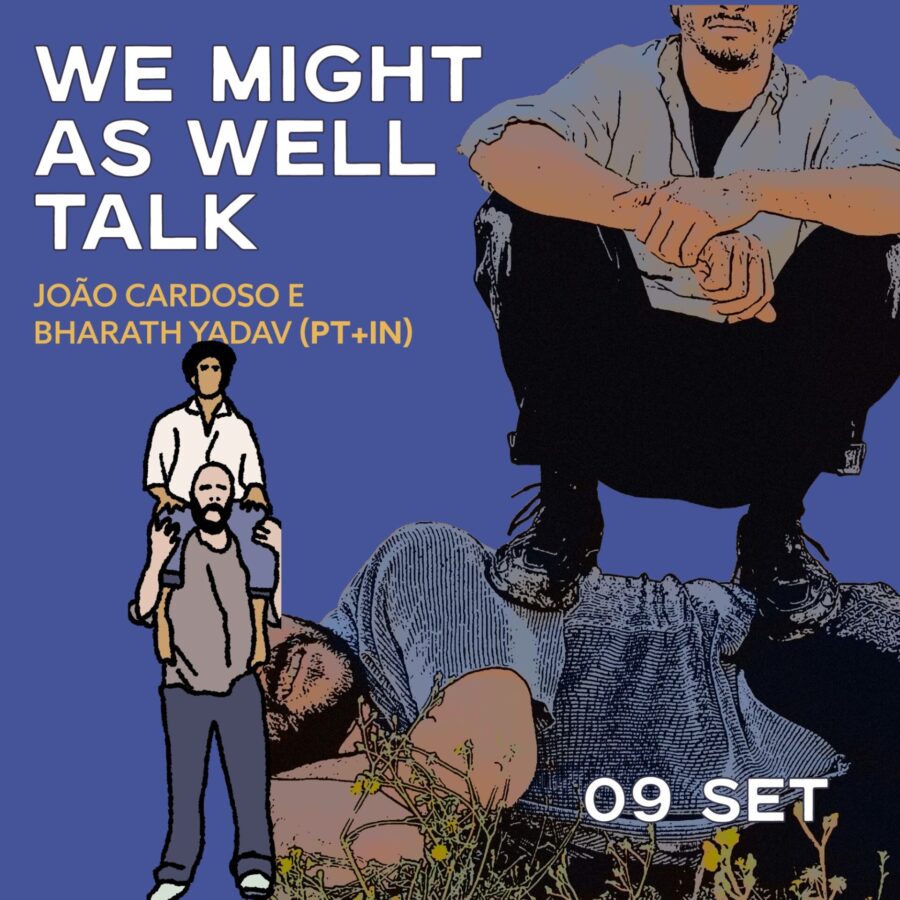
WE MIGHT AS WELL TALK • João Cardoso with Bharath Yadav
WE MIGHT AS WELL TALK
João Cardoso with Bharath Yadav (PT/IN)
9 September
10:00 pm
55 minutes
[Work-in-progress showing]
Auditório, CRL – Central Elétrica
A racialized body that never touches the ground for the entire duration of the performance. Another body that becomes the ground for the first. “We Might As Well Talk” stems from research on touch, through a forced/imposed position involving two bodies: one on top of the other, a position that is never reversed, in which they are compelled to communicate and cooperate toward a common goal. An interdisciplinary fusion of theater and dance, of the spoken word and contact and improvisation techniques, of voice and body. A duet that explores the possible relationships that arise when two bodies are placed in this situation of extreme dependence and a search for the physical and mental limits we are capable of reaching.
Artistic Info
Artistic direction and conception: João Cardoso
Creation and performance: João Cardoso and Bharath Yadav
Costumes: João Cardoso and Bharath Yadav
Sound design: João Cardoso
Lighting design: João Cardoso
Writing support: Natacha Campos
Production direction and external eye: Ricardo Machado (Outro Vento)
Artistic residencies: CAMPUS and CRL – Central Elétrica
Co-production: CRL – Central Elétrica, Pétala Colateral and CAMPUS
Support structure in India: Beru Art and Cultural Foundation
Thanks and external eyes: Surendra Tekale, Juliana Marques Fernandes and Cláudia Galhós
Bio
João Cardoso is a dance performer, choreographer, and co-founder of Pétala Colateral – Cultural and Artistic Association. His work is driven by an interest in movement as a form of communication, in text as a way of giving form to the abstraction of contemporary dance, and in the concern for the real, rather than virtual, human being.
He was born in Lisbon, where he studied at the D. Dinis Music Conservatory and later graduated from the Escola Superior de Dança in 2014. In the same year, he worked with Companhia Instável and, between 2015 and 2018, was a performer with Companhia Paulo Ribeiro.
He has also performed in Olhar Indiscreto by Patrícia Henriques (2017), and in 2018 joined Se Alguma Vez precisares da minha vida vem e toma-a by Victor Hugo Pontes, as well as Brother by Marco da Silva Ferreira (2019–2023). In 2020, he joined TIMBER by Roberto Olivan with Companhia Instável; in 2021, VIADUTO by Renan Martins; and in 2024, Há qualquer coisa prestes a acontecer by Victor Hugo Pontes (currently on tour).
Alongside his work as a performer, he has developed his own choreographic practice, highlighting works such as Stay Still, Stand Silent, and Adapted to Y&Y (co-created with Victor Gomes), as well as several pieces for the Performact programme, and Um Abraço ou Um Beijinho, co-created with Ricardo Machado.
He is also co-founder and director of the AN-TRE programme.
Bharath Yadav is a contemporary dancer, performer, and creator from India, currently based in Portugal. In 2018, he began his training in contemporary dance, Kalaripayattu (Indian martial art), and Indian classical dance at Attakkalari Centre for Movement Arts in Bangalore, India. After graduating from Attakkalari with a diploma in 2019, he continued working as a performer and co-creator in numerous projects, engaging closely with diverse communities in Bangalore. Dance and movement is his primary means of inquiry, through which he examines the multifaceted nature of human existence, including its social structures, political struggles, and psychological landscapes. He sees the body as a tool to explore and communicate these layered realities, using movement as a language beyond words. In 2023, seeking to expand and deepen his artistic practice, he joined the Contemporary Dance Interpreter / Choreographer program at Performact in Torres Vedras, Portugal. Where, he trained and collaborated with several renowned teachers and choreographers, including Tijen Lawton, Eduardo Torroja, Mate Meszaros, Cruz Isael Mata, Joao Cardoso, Juliana Fernandess, Gonçalo Lobato, Beno Novak and many others. During his final year at Performact, he specialized in choreography and presented his own works on stage: To What Time Do the Shadows Belong? (2024) and NO(W)HERE (2025). At present, his practice is driven by an ongoing research into the consciousness of the body. The living, thinking, and moving body as a physical entity in a constant state of change, balance, and renewal. Rediscovering the body as a process and not as an object. This inquiry forms the essence of his artistic practice.