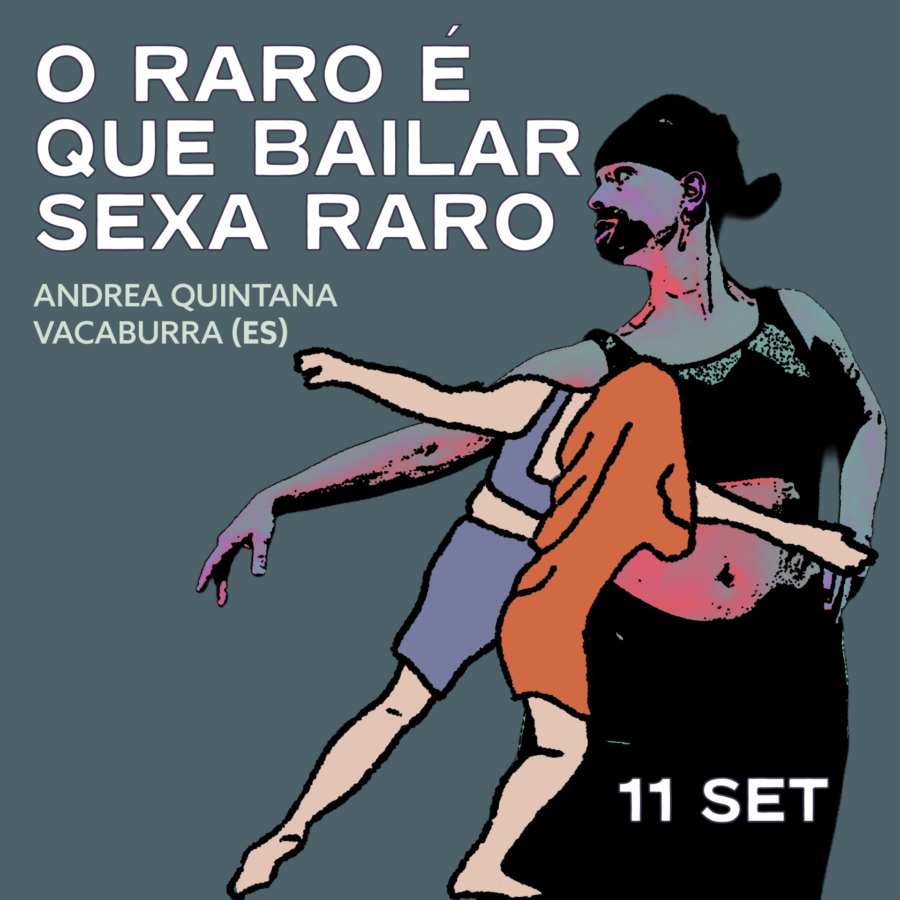
O RARO É QUE BAILAR SEXA RARO • Andrea Quintana / VACAburra
O RARO É QUE BAILAR SEXA RARO
Andrea Quintana / VACAburra (ES)
11 September
10:30 pm
50 minutes
[Performance]
Black Box, CRL – Central Elétrica
This work views dance as something contagious and invites us to dance in a space where all bodies are possible.
Dancing is dangerous; it threatens the system and complicates the situation. Dance makes people uncomfortable, affects them, unsettles them, and complicates hegemonic ways of being. Dance, contagious and invasive, destabilizes the logic of the word and threatens normative language. Dancing can be an epidemic.
This is an autobiographical piece without a biography, a trompe-l’œil, a tangled choreography, a narrative deception: a pirate choreo-biography. This is about dancing while dancing.
This dancer has no magic tricks up her sleeve. Her choreographic material is vast and at times incomprehensible; she struggles with turns on her left leg. This dancer never wanted to be Giselle. With all of us: a body in rebellion, traversed, in revolt; the non-normative dancer, the fakir dancer, the miracle worker, the subaltern.
Artistic Info
Creation: Andrea Quintana
Choreography and performance: Andrea Quintana
Direction and dramaturgy: Gena Baamonde + Andrea Quintana
Texts: VACAburra, inspired by Joanna Russ and Linn-Liniker
Lighting: Baltasar Patiño
Sound design: Davide González + Andrea Quintana
Image: Muller 6 Ollos Costumes: Saturna
With the support of: Creative residency
Residencias Paraíso from Colectivo RPM, CDG Salón Teatro
Creative residency at A Normal, cultural intervention space. Artist support from the Corunha City Council and Galicia Danza Contemporánea.
Bio
VACAburra was born in 2019 as a contemporary creation project in Galicia, arising from the convergence of the trajectories of Andrea Quintana and Gena Baamonde. Their work is shaped by a hybridization of languages, feminism, sex-gender diversity, humour and theoretical-practical research, with the body as the principal driver of their creations. Over the years they have created pieces such as O raro é que bailar sexa raro, Metodoloxías Carroñeras para Corpos Invertidos, Familia Nijinska and Festina Lente — pieces offering a critical reflection on bodies and hegemonic narratives, on the poetic-political dimension of stage creation, in which “danzalismos” (a fusion of dance and vandalism) function as fundamental methodological tools.