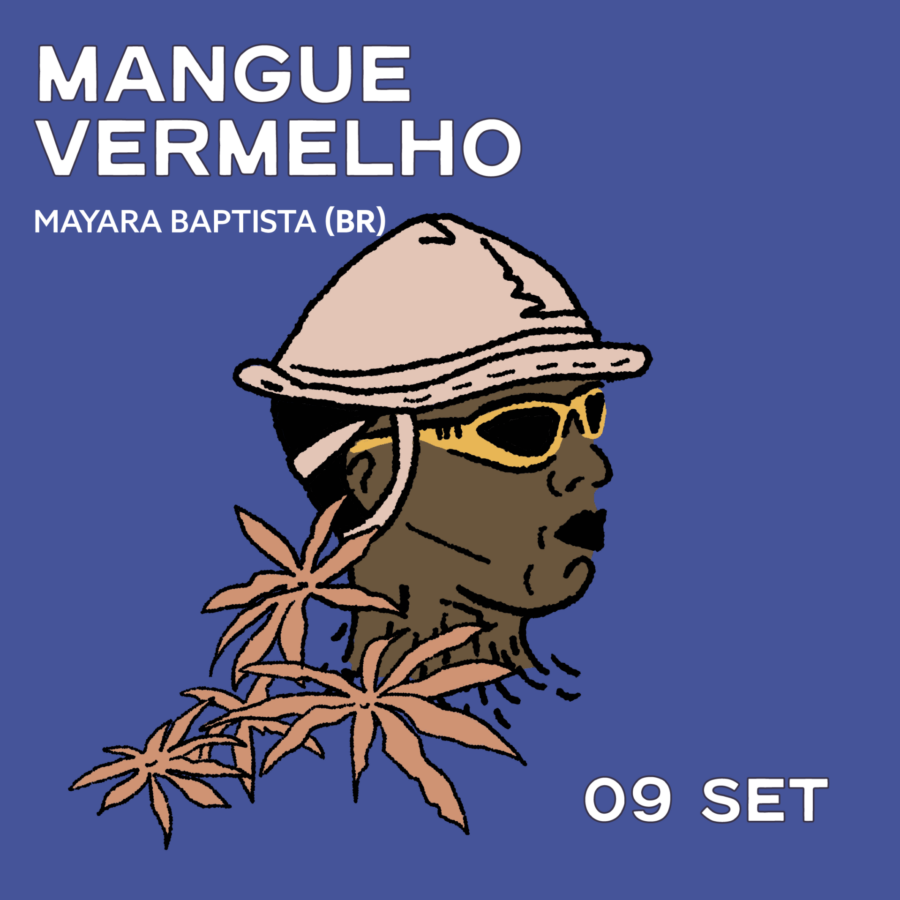
MANGUE VERMELHO • Mayara Baptista
MANGUE VERMELHO
Mayara Baptista
9 September
7:30 pm
45 minutes
[Work-in-progress showing Iberescena]
Preta, CRL – Central Elétrica
Mangue Vermelho is a performative research project by Mayara Baptista (e.t), a Brazilian Afro-Indigenous artist.t, that explores ancestry, territory, and memory through a sensitive listening to the relationships between the body and nature. The work proposes an encounter between Afro-diasporic and Indigenous cosmologies, understanding the human as part of a living, interconnected web of existences, where matter, spirit, and environment are inseparable.
The mangrove forest and Ninki Nanka structure the poetic framework of the research: the mangrove forest as a space of mixing, instability, and coexistence between different worlds; Ninki Nanka as a mythical presence that evokes the invisible, the indomitable, and the forces that traverse nature. These images spark a reflection on transformation, continuity, and ways of life that resist erasure.
The work traverses music, theater, and dance as inseparable languages, in dialogue with references to Brazilian indigenous dances and the bodily knowledge of Candomblé. Mangue Vermelho creates a space of experience where body and territory merge, opening a sensitive field of listening, presence, and connection with what flows through us.
Artistic Info
Creation, dramaturgy, lighting and sound design: Mayara Baptista
Support: Linha de Fuga / Residências Contra|o|Tempo and Cena Lusófona
Bio
Mayara Baptista (e.t.) is an Afro-Indigenous Brazilian ANTIdisciplinary artist.t working across performance, music, theatre, and contemporary Afro-Indigenous dance. Their practice investigates ancestry, memory, territory, and the politics of voice, exploring the intersections of body, sound, and landscape. Recent works include Vozes (Open Out Festival, Norway, 2025), Onde Está a Criança Aqui Dentro? (Festival Precárias III, Lisbon, 2025), and Mangue Vermelho (Festival Linha de Fuga, Portugal, 2024–ongoing), a research project inspired by mangrove ecologies and Afro-diasporic cosmologies. A member of Teatro Oficina for six years, they currently develop projects between Berlin, Portugal, and Brazil.