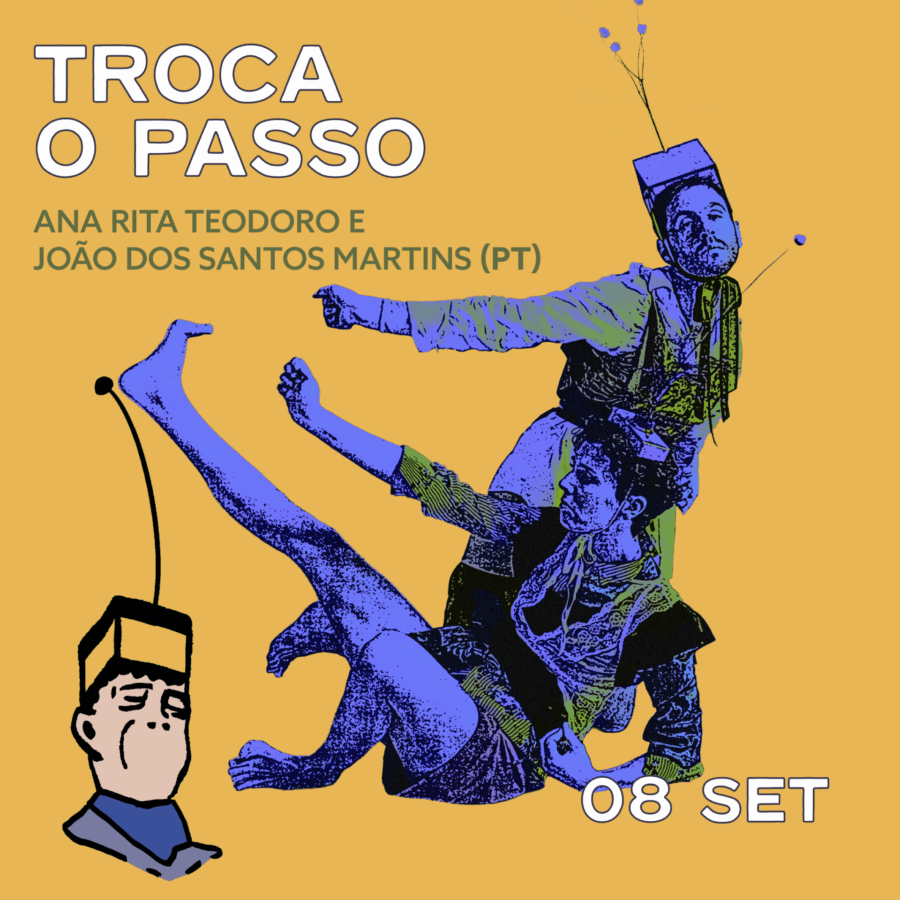
TROCA O PASSO • Ana Rita Teodoro e João dos Santos Martins
TROCA O PASSO
Ana Rita Teodoro and João dos Santos Martins (PT)
8 September
7:30 pm
55 minutes
[Performance]
Nave, CRL – Central Elétrica
The expression “troca o passo” is used to indicate the second part of a date without a specific year (…one thousand six hundred and troca o passo). The expression can also be used literally to mean switching feet, in order to synchronize or desynchronize one’s steps with another person.
Following “Trolaró,” “Troca o Passo” is the second duet that Ana Rita Teodoro and João dos Santos Martins have developed as a pretext for researching and reinventing themselves as artist-dancers detached from the idea of a specific project.
Walking is the present trace of a story that has already begun, the blossoming and fading of a form in progress. Is it possible to move forward while maintaining a connection to the black holes of history? The elliptical curves of the world pull us into archaeological records. We move forward and backward, find our rhythm and fall behind, run and get ahead, stop, yet keep moving.
A duet walking with butoh.
Artistic Info
Choreography and performance: Ana Rita Teodoro and João dos Santos Martins
Light, space and arrangements: Filipe Pereira
Costume: Composed of pieces worn on a Friday morning
Musical inspirations: Knee (1986) by Meredith Monk; goji sound on the chaimu of Saruhashi village
Executive production and administration: Catalina Lescano, Francisca Salema and Maria Monteiro | Associação Parasita, Association Mimaï
Residencies: Casa da Dança, Espaço Parasita, Forum Dança (Portugal), Hijikata-Nakanishi Memorial Saruhashi Soko (Japan)
Support: NPO Dance Archive Network, DGArtes
Internationalisation Support Programme, Camões – Portuguese Cultural Centre in Tokyo Production: Associação Parasita
Thanks to: Toshio Mizohata, Connor Scott, Yumi Tateishi, Morishita Takashi, Takao Kawaguchi, Yui Baba, Casa da Dança, Dimitri Rey
Bio
Ana Rita Teodoro(Barreiro, Portugal, 1982) holds a Master’s degree in “Dance, Creation and Performance” from the CNDC in Angers and the University of Paris 8, where her research developed the creation of a “Delirious Anatomy.” More recently, she carried out research into the transmission of butoh dance with support from the Fundação Calouste Gulbenkian and the CND (Centre National de la Danse, France), which culminated in the danced lecture “Your Teacher, please.” She studied the body through the disciplines of anatomy, paleontology and philosophy at c.e.m. with Sofia Neuparth, and Chi Kung at the Lisbon School of Traditional Chinese Medicine. She has created the pieces “MelTe,” “Orifice Paradis,” “Sonho d’Intestino,” “Palco,” “Assombro” and “FoFo.” She collaborates with various artists on one-off projects. She was an associate artist at the CND between 2017–2019 and is currently an associate artist of Associação Parasita.
João dos Santos Martins (Santarém, 1989) is an artist whose work spans several forms that permeate dance, exploring formats such as choreography, exhibition and editing. His practice values collaborative modes of working, and he has created pieces such as “Projecto Continuado” (2015) — winner of the SPA Authors’ Prize — and “Cooperativa” (2025), with Ana Rita Teodoro, Clarissa Sacchelli, Daniel Pizamiglio, Filipe Pereira and Sabine Macher, as well as “Está Visto” (2018), with Ana Jotta and Joana Sá. He has performed in works by Moriah Evans, Ana Rita Teodoro, Xavier Le Roy, Eszter Salamon, Boris Charmatz, Marcelo Evelin, Jérôme Bel and Rui Horta, among others. His interest in the genealogies of dance history led him, together with Ana Bigotte Vieira, to create a tool for mapping dance in Portugal — “Para Uma Timeline a Haver” — and to found a biannual journal — “Coreia” — dedicated to writings by artists and about the arts. He occasionally writes and curates.
PARASITA (2014) is an artistic association based in Lisbon, dedicated to creation, production and research in dance and performing arts. It is funded by DGArtes and is a member of the REDE network.